streets in plain view from a distance

A new trend features photographers’ translations of Google Street View scenes—accompanied by remarkable creative messaging—often topical to urban issues.

One such effort, Doug Rickard’s A New American Picture, focuses on challenged American cities such as Camden and Detroit, and displays a world remarkably opposite the technology used to depict his presented scenes. Click here to see his groundbreaking work.

Similarly, words are not always necessary to describe how public rights of way are used around the world, and travel is not a prerequisite of viewing the interaction of foot, wheel and pavement.

Here, without more words, are portrayals of a Sunday morning visit to Japan, Mexico, Brazil and Finland, with both familiar and novel interactions in plain view.

Credit the wonders of Google for these street-oriented images, and Mr. Rickard for inspiring the myurbanist use of camera and software to enhance such virtual visits from afar.


defining provocative urbanism

provocative urbanism [pro·voc·a·tive ur·ban·ism] [noun]:  stimulating or controversial forms of urban community, which demonstrate vitality and human interaction reminiscent of traditional city life.

Amid today’s writing on cities, there is a theme afoot.  Something called provocative urbanism could define today’s excitement and communication about cities, as the focus of multiple articles, tweets, videos and lectures.

After all, we like cities when they work their magic of safe, dynamic and walkable multi-purposing, and provocative urbanism could aptly advertise such success.

No one has yet championed provocative urbanism among the many existing urbanisms of the airwaves. In particular, urbanism wordsmiths such as Yuri Artibise and Jason King haven’t kicked this tire (in fact, Yuri picked other monikers for his ‘P” Urbanism in his recent alphabetical list, starting with “paid”).

The Provocation

But just what are we provoking, and why and how?

Some of us are simply geeks about urban areas. Some see them as salvation—whether as city over suburb, or in the realm of economics, architecture, politics, law, transportation and health–or all together, in one of those silo-free nirvanas of sustainability, resplendent of both creative and contemporary buzz.

But a Google search for provocative urbanism produces surprisingly few results, and those which readily appear suggest an interesting theme: it is provocative to harken back to unplanned, spontaneous urban patterns in invoking our vision of the urban future.

In fact, one such Google result links to an essay on Richard Sennett’s The Uses of Disorder and champions urban complexity, randomness and conflict over prescriptive approaches that indiscriminately mandate technology (light rail) or policies (smart growth).

In an interesting, more structured parallel, Trent Noll has written recently in a Planetizen essay that the naturally occurring basics of placemaking (ie, comfort, variety, entertainment and walkability) have existed for time immemorial in successful cities, but today’s design challenge is a more purposeful implementation of such basics with a value-engineered mindset, to spur investment incentives for savvy developers.
At the center of provocation is the tension of imposition of order versus the wonders of a naturally changing city, often prompted by thematic catalysts and campaigns (e.g. Streets for All Seattle).

This tension is not new. Even in the 1920’s, colleagues of Clarence Perry critiqued his later well-known “neighborhood unit” approach in the context of the existing urban fabric of the New York region, then adapting to repercussions of automobile proliferation. Eminent Scottish town planner Thomas Adams wrote:

[D}iscussions… seem to suggest that neighborhood life is something that can be created. All city life is neighborhood life in some form. We should not discuss it as something that is non-existent and can be brought into being, but as something that exists in forms that need to be changed, improved and better organized. (Memorandum, Adams to Perry, January 23, 1928, Papers, Regional Plan Association, Cornell University).

Communicating the Provocation

There is something about the human condition that celebrates successful community, where and when we can co-exist safely, in a mutually supportive way. This especially rings true when this community can be conveyed through media that inspire the senses, much like the original experience of “being there”. As implied above, perhaps this celebration is most provocative when it occurs spontaneously, something seen more often in organic old world environments than in the new.

So, ironically, perhaps we wish to celebrate the successes of the unpredictable and disjointed as much as the successes of the prescriptive and planned. Unintentionally or outright, we often dwell in the incredible irony where the prescriptive and planned achieve what used to occur naturally.

Today, provocative urbanism can be communicated simply and democratically, which, frankly, adds even more provocation. With the wonders of technology and the grassroots web, we can now instantly connect around the world, and immediately display that the urban vernacular can be simultaneously multicultural and timeless, and that the two dimensions of print can easily become sight, motion and sound. Witness Seth Sherwood in the New York Times on December 1:

Damascus loves to flaunt its age. It claims to be the world’s oldest inhabited city — replete with biblical and Koranic lore, Roman ruins, ancient Islamic edifices and Ottoman-era palaces. But that’s not to say the Syrian capital is stuck in time. Dozens of centuries-old mansions have been reborn as Mideast-chic hotels, and fashionable shops and restaurants have arisen in the ancient lanes of the Old City. Throw in a fledgling generation of bars and clubs, and the age-old metropolis has never looked so fresh. [emphasis added]

In summary, today’s organizing institutions of land use–constitutional precepts of private property, or a zoning code or judge’s ruling–can be spun through time and space into a prospective dictionary term that adds even more color to the already crowded urban lexicon.

This article was authored as the introduction to a presentation, “Vignettes of Provocative Urbanism”, which will take place Thursday, December 9 in Seattle. Learn more via Great City, here.

re-visioning neighborhood and the city, then and now

Today’s efforts to recreate elements of the city, of whatever prescription of urbanism (e.g. “new”, “landscape” or “ecological”) often turn on issues once considered in design competitions long forgotten.

Central to such efforts, new or old, is the relationship of a city segment to the surrounding urban area and the role of public streets in the integration process between neighborhood and city.

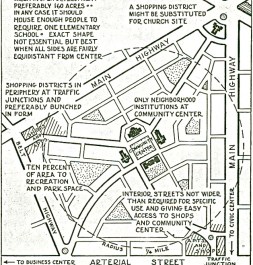
A sometimes overlooked legacy can be rediscovered in the Chicago of 100 years ago, where a still-relevant competition once summarized by Lewis Mumford centered on integrating neighborhood housing with “markets, schools, churches, and other institutions that serve the local area rather than the city as a whole”.

In December 1912, the City Club of Chicago staged a competition for the design of a quarter-section of the Chicago grid. The effort was later documented by Alfred B. Yeomans, a Chicago landscape architect who edited the competition’s publication in 1916. He acknowledged new attention to the planned development of the local area premised on the increasingly comprehensive role of the street. He noted that the “purely mechanical extension of existing street systems is giving way to scientific methods of development based on a careful study of the probable economic, social and aesthetic needs of prospective inhabitants”.

The various entries stressed the fundamental role of the street in integrating city and neighborhood.

Several of the entries emphasized the role of the local street system and public open spaces. The first prize entry, by Chicago architect Wilhelm Bernhard, contained a community center and stressed deterrence of through traffic from surrounding Chicago. Arthur C. Comey, the second-prize winner, employed the English allotment garden within blocks, with houses facing inward, an intermediate street system for local use, recreation spaces, and buildings grouped about small parks.

Other entries took up more directly the question of integration with the surrounding city, thereby starting a debate on the worth of isolated communities at variance with the surrounding grid. This debate has never fully resolved, especially as modes of transportation expand, while contemporary thinking increasingly emphasizes the relationship and proximity of home to work.

G.B. Cone's Chicago competition entry. (Source: Yeomans 1916: 34)

In particular, landscape architect G.B. Cone noted that the proposed neighborhood was not destined to exist independent of Chicago’s entirety. He argued for retention of the gridiron throughout, foreshadowing today’s defenders of continuity within the grid and implying that the imposition of a curvilinear scheme would negatively isolate the community from the prevailing pattern of development. Nonetheless, he emphasized the use of interior-block open space and the community center.

W. Drummond's Chicago competition entry shows a bird's-eye view and a typical city block. (Source: Yeomans 1916: 37,41)

Similarly, William Drummond, a Prairie School architect and disciple of Frank Lloyd Wright, proposed grid-based “neighborhood units” (well prior to large-scale adoption of the concept by Clarence Perry and others) with allotment gardens and interior courts.

These designs were but a fraction of the Chicago competition’s entries. Yet they exhibited best the perceptive synthesis of reform ideals and site planning sensitive to the uses of the street within the new arena of the urban neighborhood.

In response to such efforts, the competition provided a “Sociological Review of the Plans” by Dr. Carol Aronovici, then director of the Bureau of Social Research of Philadelphia, and a lecturer on housing and town planning at the University of Pennsylvania. Aronovici cautioned that the new, local street plans within specific areas should not proceed without determination of “the relationship that this area is intended to bear to the whole”.

Aronovici, like many of today’s urbanists, saw virtue in the grid. He viewed the abandonment of the gridiron street system as a possible symptom of an “artificial and radical” attempt to set the planned community off from its surroundings. He urged the location of public and semi-public buildings on the
community’s periphery rather than grouped about local community centers, so as to preserve contacts with adjacent neighborhoods. Finally, he perceptively identified problems inherent in public regulation and ownership of inner block open spaces and saw the necessity of assuming community maintenance of public areas:

The whole question of “shut-in spaces,” whether they be parks, playgrounds or allotment gardens, is one that should be carefully weighed. The line of cleavage between public and private ownership, between public and private maintenance, should be sharply drawn. While I am heartily in favor of extending the bounds of public ownership, I am opposed to common ownership that is not coupled with common responsibility.

In the spirit of both deja vu and amnesia (concepts combined by American actor/writer Stephen Wright), the debates of the legacy Chicago competition continue, 100 years later, as the dialogue on streets and neighborhood-urban area integration lives on.


For more on the precedential Chicago Competion, see Yeomans, A.B., ed. 1916. City Residential Land Development. Chicago: University of Chicago Press.

This entry was adapted from Wolfe, C.R. “Streets Regulating Neighborhood Form”. Ch. 7. in Moudon, A.V., 1987,1991. Public Streets for Public Use. Columbia University Press. It was also republished in SustainableCitiesCollective on November 21, here.

what about “shapes of avoidance” on the landscape?

The form of urban settlements and appearance of constituent structures reflect underlying culture and regulation.

In times of change, such form can alter, to reflect the impact of new or modified policy or regulation. Resulting shapes of compliance, such as the pattern of height, bulk and density dictated by a new downtown zoning code, has the potential to reinvent the urban landscape.

But the urban landscape can also be dramatically altered by “shapes of avoidance”.

Consider, in the context of everyday urbanism, those shapes and patterns dictated by avoidance of regulation.

Here, I am discussing not just spontaneous parklets and sidewalk tables of “guerrilla urbanism” or “pop-up” cities, but examples of urban form that result when policy or regulation is creatively defied on a widespread basis.

Call it the urban landscape’s manifestation of French/American microbiologist Rene Dubos‘ classic discourses on human adaptation to environmental change, Man Adapting and So Human an Animal.

A compelling example is the alteration of a southern Italian landscape in the 15th to 17th centuries premised on the avoidance of taxes or fees–the apparent explanation for the unique shape of trulli houses in Puglia–and the resulting appearance of the Itria Valley and the town of Alberobello.

As the story goes, conical houses that don’t look like houses were built without mortar for easy destruction so the Counts of Conversano could avoid property tax payments on permanent structures (such as residences) to the King of Naples.

What are today’s trulli?

Are they merely a list of unenforced zoning violations (e.g. unpermitted home occupations, illegal accessory dwellings, unsanctioned tent cities, vehicles on lawns) or perpetual temporary uses?

Given the extent of land use regulation today, could spontaneous, repetitive trulli-like “shapes of avoidance” define a sustainable urban landscape more interesting than those that are planned?

Or are the most visible “shapes of avoidance” now limited to freedom of expression in the ballot box and on urban walls?

After all, some might argue that graffiti and the recent electoral landscape are the trulli of our times.

This article was republished in SustainableCitiesCollective on November 14, here.

urban edibility meets urban sustainability

Here’s to the drama of wry movie trailers with a message, to inspire continuing regulatory flexibility for open air markets in America.