
provocative urbanism [pro·voc·a·tive ur·ban·ism] [noun]: stimulating or controversial forms of urban community, which demonstrate vitality and human interaction reminiscent of traditional city life.
Amid today’s writing on cities, there is a theme afoot. Something called provocative urbanism could define today’s excitement and communication about cities, as the focus of multiple articles, tweets, videos and lectures.
After all, we like cities when they work their magic of safe, dynamic and walkable multi-purposing, and provocative urbanism could aptly advertise such success.
No one has yet championed provocative urbanism among the many existing urbanisms of the airwaves. In particular, urbanism wordsmiths such as Yuri Artibise and Jason King haven’t kicked this tire (in fact, Yuri picked other monikers for his ‘P” Urbanism in his recent alphabetical list, starting with “paid”).
The Provocation
But just what are we provoking, and why and how?
Some of us are simply geeks about urban areas. Some see them as salvation—whether as city over suburb, or in the realm of economics, architecture, politics, law, transportation and health–or all together, in one of those silo-free nirvanas of sustainability, resplendent of both creative and contemporary buzz.
But a Google search for provocative urbanism produces surprisingly few results, and those which readily appear suggest an interesting theme: it is provocative to harken back to unplanned, spontaneous urban patterns in invoking our vision of the urban future.
In fact, one such Google result links to an essay on Richard Sennett’s The Uses of Disorder and champions urban complexity, randomness and conflict over prescriptive approaches that indiscriminately mandate technology (light rail) or policies (smart growth).
In an interesting, more structured parallel, Trent Noll has written recently in a Planetizen essay that the naturally occurring basics of placemaking (ie, comfort, variety, entertainment and walkability) have existed for time immemorial in successful cities, but today’s design challenge is a more purposeful implementation of such basics with a value-engineered mindset, to spur investment incentives for savvy developers.
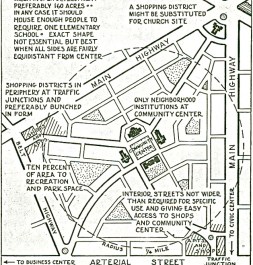
At the center of provocation is the tension of imposition of order versus the wonders of a naturally changing city, often prompted by thematic catalysts and campaigns (e.g. Streets for All Seattle).
This tension is not new. Even in the 1920’s, colleagues of Clarence Perry critiqued his later well-known “neighborhood unit” approach in the context of the existing urban fabric of the New York region, then adapting to repercussions of automobile proliferation. Eminent Scottish town planner Thomas Adams wrote:
[D}iscussions… seem to suggest that neighborhood life is something that can be created. All city life is neighborhood life in some form. We should not discuss it as something that is non-existent and can be brought into being, but as something that exists in forms that need to be changed, improved and better organized. (Memorandum, Adams to Perry, January 23, 1928, Papers, Regional Plan Association, Cornell University).
Communicating the Provocation

There is something about the human condition that celebrates successful community, where and when we can co-exist safely, in a mutually supportive way. This especially rings true when this community can be conveyed through media that inspire the senses, much like the original experience of “being there”. As implied above, perhaps this celebration is most provocative when it occurs spontaneously, something seen more often in organic old world environments than in the new.
So, ironically, perhaps we wish to celebrate the successes of the unpredictable and disjointed as much as the successes of the prescriptive and planned. Unintentionally or outright, we often dwell in the incredible irony where the prescriptive and planned achieve what used to occur naturally.
Today, provocative urbanism can be communicated simply and democratically, which, frankly, adds even more provocation. With the wonders of technology and the grassroots web, we can now instantly connect around the world, and immediately display that the urban vernacular can be simultaneously multicultural and timeless, and that the two dimensions of print can easily become sight, motion and sound. Witness Seth Sherwood in the New York Times on December 1:
Damascus loves to flaunt its age. It claims to be the world’s oldest inhabited city — replete with biblical and Koranic lore, Roman ruins, ancient Islamic edifices and Ottoman-era palaces. But that’s not to say the Syrian capital is stuck in time. Dozens of centuries-old mansions have been reborn as Mideast-chic hotels, and fashionable shops and restaurants have arisen in the ancient lanes of the Old City. Throw in a fledgling generation of bars and clubs, and the age-old metropolis has never looked so fresh. [emphasis added]
In summary, today’s organizing institutions of land use–constitutional precepts of private property, or a zoning code or judge’s ruling–can be spun through time and space into a prospective dictionary term that adds even more color to the already crowded urban lexicon.
This article was authored as the introduction to a presentation, “Vignettes of Provocative Urbanism”, which will take place Thursday, December 9 in Seattle. Learn more via Great City, here.


