towards canine equity in the city

Now is the time for the urban dog.

DogEquity_ChuckWolfe1

One of the most immediate cultural distinctions a traveler notices in France is omnipresent,well-behaved dogs, often quite unlike their detached American cousins (perhaps including my own). In a matter of a few weeks, I have assembled a mental diary of locational examples that illuminated the integrated role of multi-modal canine life.

Examples included sitting on adjacent train seats, in restaurant diners’ laps and on park benches next to owners. Not to mention my almost tripping over many, child-like, aisle-shopping companions.

These observations remind me, frankly, that we often regulate away the opportunity for certain, traditional life-enhancements in the interest of public health, something that probably made sense in a more feral age.

DogEquity_ChuckWolfe3

DogEquity_ChuckWolfe2

But if we are truly on the way to inevitable urbanization, I vote for the extension of the mixed use, sharable spirit to enable more equity for the urban canine.

I, for one, don’t mind sitting next to a well-behaved poodle, or shopping with dogs in both the Gucci in Cannes, as well as the Guccy Wawa located a few towns away.

Images composed by the author in Saint Tropez, Cannes and Fréjus, France. Click on each image for more detail. © 2009-2014 myurbanist. All Rights Reserved. Do not copy.

For more information on the role of personal experience in understanding the changing city, see Urbanism Without Effort, an e-book from Island Press.

on learning from urban immersion

Immersion_ChuckWolfe3

How we experience purchases of coffee and baked goods may sound fairly trivial, and elitist.

But, based on my current immersion in the south of France, I have come to think these simple interactions offer valuable lessons for how to live in neighborhoods and cities.  The rhythm of traditional transactions, with deep cultural roots, offers significant lessons about the role of expertise in daily life.

I saw it in Fréjus this morning in the wisdom of the coffee vendor.  In a transaction that was more consultation than transaction, he custom-ground “moka sauvage” beans after carefully listening to our stated needs, about the flavor we were looking for, and how we prepare our coffee—in an Italian stove-top espresso pot.  We emerged from his small commercial space with an impeccable recommendation.  A fine diagnosis, I thought, from a doctor of arabica.

Similarly, yesterday, while sampling hot chocolate, in Roquebrune-sur-Argens, I watched a man enter and review the lemon pastry options de jour.  After some discussion, reflecting the expertise of the vendor, he chose a lemon tart over a lemon cake.  The dialogue was brief but refreshingly complete, something akin to a computer or camera purchase in another world.  It was as if time had turned back to something that has always been or something that we are always searching for.

Inspired by the tradition of this pastry transaction, it was our turn. How to decide: a green tea sponge cake, with blackcurrant filling, or a dark chocolate mousse cake with coffee filling?

Immersion_ChuckWolfe4

One or both, and if both, when to eat?

Again, the old world, pre-Apple Store suggestion by the shopkeeper: “Un gateau pour aujourd’hui, et un gateau pour demain” (one cake for today, and one cake for tomorrow), we agreed.  And then the punchline, as the young woman switched to English with a beam in her eye:

“And, if you eat both today, you can come back tomorrow”. (She hopes, perhaps).

Lesson learned from this extended time away:  Remember the urban rituals where you can still find them, whether closer or farther from home.

Images composed by the author in Fréjus and Roquebrune-sur-Argens, France. Click on the image for more detail. © 2009-2014 myurbanist. All Rights Reserved. Do not copy.

For more information on the role of personal experience in understanding the changing city, see Urbanism Without Effort, an e-book from Island Press.

why the ‘finesse of the avenue’ is what cities need

Fourth in an illustrated series about place-decoding from the South of France.

_DSC1521

The Finesse of the Avenue

Last month in Cassis, the Avenue Victor Hugo told the stories surrounding its pavement and curbs.  People walked the Avenue, between a small square-with-fountain and the quay, while the trees, awnings and overhangs together cast the shadows that passers-by always need. The shiny, at-angle paving stones reflected the light in ways seldom seen on a street.  And ambient noise seemed pleasant and appropriate, muffled perhaps by the envelope of finesse just described.

My experience in Cassis was a major reminder, about how several factors can combine to create a “finesse of the avenue”; a noteworthy confluence of people—both natives and tourists— of physical aspects of the urban environment, and of the human senses of sight and sound.

In short, natural, built and human factors merged in a perfect storm of light, trees, stones and scale.

But, of course,  it was not a storm at all.  It was an exemplary venue to practice the “place decoding” called for in my three earlier series entries.

The Human Impact of a Simple Fix

While Cassis is known as a fishing village turned touristic haven (and a departure point for dramatic rock faces above the Mediterranean and remarkable inlets along coast, a short distance from Marseille), this essay is hardly a travelogue.

Rather, it focuses on the human impact of one of the simplest and most common municipal interventions: Closure of a street to automobiles on Market Day, or during times of heavy use of a place (in this case, to board tour boats or visit the beach on a September Saturday).  As a result, inherent and longstanding qualities of the place re-emerge for the people.

The two sets of photos below show Cassis with full automobile access, off-season (via Google Street View), and on that September late morning, when I photographed street use at a more human scale.  Comparing the two, it is not difficult to distinguish the ho-hum on the left from the right hand’s  finesse of the avenue.

Screen Shot 2014-10-05 at 3.28.25 PM

CassisAllure1_ChuckWolfe

Screen Shot 2014-10-05 at 4.58.27 PM

CassisAllure3_ChuckWolfe

The placemaking movement has already marshaled the festival imagery  implied here. We know that medieval townscapes and small streets are not a precursor to experiments that allow the value of public spaces and mix and re-enable non-motorized transportation modes. Transformations such as New York City’s Times Square pedestrian plaza are increasingly well-known, on their way to best practice status for our cities and towns.

The Role of Magic and Finesse in Urban Definition

In a place like Cassis, however, it’s more than cutting off the cars.

Some places have magic elements that combine in unique, empowering ways that inordinately impact the urban experience.  I have written about those special locales in Urbanism Without Effort and inferred associated people-based criteria of comfort and scale.  Just as those criteria became clear for me in London’s Neal’s Yard, and parts of Portland, Oregon’s small, cohesive downtown blocks, they reemerged with vigor in the Cassis experience.

The additional ten images below show the essentials of everyday life, carried out in public, with comfort and apparent ease. While some are walking, others are selling, shopping, reading, attending to pets, or each other. These essentials stand out amid the merger of private and public, and the temporary compromise of the automobile. The “envelope of finesse” of light, trees, shade and reflection described above, worked a magic aura, in my opinion, without over-designed intervention.

Communicating this “finesse of the avenue” is as valuable as the scholars and thought leaders’ views about successful urban attributes. Places with the look and feel of Avenue Victor Hugo, if interpreted in context, illustrate successful attributes of urban public spaces, and help define the infrastructure and services that cities should equitably provide. It’s a gut-level, observational process, which every one of us has the means to carry out, to better understand the underlying make-up of successful city life.

CassisAllure5_ChuckWolfe

CassisAllure6_ChuckWolfe

CassisAllure7_ChuckWolfe

CassisAllure8_ChuckWolfe

CassisAllure9_ChuckWolfe

CassisAllure10_ChuckWolfe

CassisAllure11_ChuckWolfe

CassisAllure12_ChuckWolfe

CassisAllure13_ChuckWolfe

CassisAllure14_ChuckWolfe

Images composed by the author in Cassis, Provence, France, with the exception of the indicated Google Street View comparison photographs. Click on the image for more detail. © 2009-2014 myurbanist.  All Rights Reserved. Do not copy.

Coming next: Lessons in Housing from the Domaine of the Caravan.

For more information on the role of personal experience in understanding the changing city, see Urbanism Without Effort, an e-book from Island Press.

‘inevitably urban’ and the role of the people

InevitablyUrban_ChuckWolfe101

Inevitable Urban Times

These times seem so inevitably urban.  Of course, my wry remark comes from a city-dweller in a post-recessionary Seattle, where new construction appears at every turn.

Here, civic dialogue focuses on the social repercussions of growth, such as affordability of urban housing (“build more“, said yesterday’s Seattle Times), the proper range of housing types, and how residents will travel from here to there.

These are also times to think again about how to “create scalable solutions for city leaders to share with their constituencies across the world”, according to The Atlantic’s CityLab 2014 event underway now in Los Angeles.

InevitablyUrban_ChuckWolfe17

Attention to human opportunities in the city is now commonplace, with recurring urbanism, placemaking and urban innovation events like CityLab 2014, The Placemaking Leadership Council and The Future of Places all occurring within the last month. Proffered solutions abound, aided by technology, applications and provocative presentations, both live and online.

Oratory and Shakespeare Define the City

But it’s worth remembering that inquiry about the how to fulfill human opportunities is longstanding. There is undeniable precedent in storied oratory, arguably the internet of ancient times.

The Greek poet, Alcaeus of Mytilene (680-511 BC) (as reported by Roman-era sophist Aelius Aristides in later oratory) established human opportunities as central to his definition of the city:

Not houses finely roofed or the stones of walls well builded, nay nor canals and dockyards make the city, but men [sic] able to use their opportunity [emphasis added].

Sound familiar?

The human part of the built environment has echoed in other, much-quoted prose. Beyond the Greek sophists and orators (themselves criticized for educating only those who could afford the price), Shakespeare’s better known quotation, from Coriolanus, Act 3, Scene 1, also set the tone:

“What is the city but the people?”

What I Learned About Cities

In my case, personal background complements history.

In one of his last presentations, at a major “21st Century City” conference he helped organize in 1988 in Phoenix, my father (late Urban Planning Professor Myer R. Wolfe) quoted Alcaeus in his holistic conference keynote remarks.

How, he asked, can interdisciplinary forces be marshaled to make an accessible urban form (citing Alcaeus’ human “opportunities”) for the 21st century? “The question has to be asked—opportunities for what?”, he noted, pointing to, inter alia, limitations on quality of life inherent in long commutes and related life choices,  issues of density v. intensity, as well as urban character across both urban and suburban patterns. (See The City of the 21st Century, M. Pihlak, Ed., Arizona State University, 1988).

In reviewing those remarks just yesterday, his references both to Greek oratory and his predictive questions about this century sent me searching for universal, human imagery. Because it’s the people who define the city, we should look at them, closely.

It’s the People, Stupid

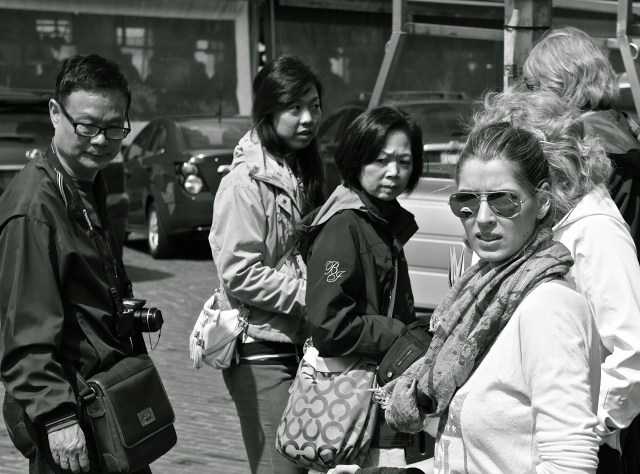
I have compiled 25 photographs for this essay—taken in multiple locations since 2009, including cities on four continents.  The photographs are presented in black and white, to better show the contrast between the human and built environment, yet also emphasize the undeniably symmetry between.

InevitablyUrban_ChuckWolfe03

My intentions are simple:

First, I want to straightforwardly illustrate fundamental traits of city dwellers across cultures, distance and time. Such traits include talking, eating, singing, watching, shopping, walking, sitting, learning, growing and aging, seeking shelter from climate, and blending with technologies of communication, travel and illumination.

Second, beyond the other ample media available to assess city life and prospects, I want to challenge the reader to think about how best to maximize the opportunities for those pictured, and those around us, and to realistically assess what we see.

As explained here, this story of “urban inevitability” has traveled through sophism—a once-revered (albeit privileged) form of teaching, across the ages. But the very point of such sophism—defining the city on human terms—should not morph to “sophistry”, a more modern term reflective of deceit and specious debate.

Finally, Just Look at the People and Learn

Here’s hoping that the interspersed photographs above and below will illustrate what Alcaeus meant long ago, as revisited in 1988 by my father and in new forms, through the gatherings and events today.

I would venture that to be “able to use the opportunity” of the city is a perpetual challenge best observed in the conduct of the users themselves.

InevitablyUrban_ChuckWolfe111


InevitablyUrban_ChuckWolfe04

InevitablyUrban_ChuckWolfe06

InevitablyUrban_ChuckWolfe07

InevitablyUrban_ChuckWolfe09

InevitablyUrban_ChuckWolfe10

InevitablyUrban_ChuckWolfe11

InevitablyUrban_ChuckWolfe12

InevitablyUrban_ChuckWolfe13

InevitablyUrban_ChuckWolfe14

InevitablyUrban_ChuckWolfe15

InevitablyUrban_ChuckWolfe16

P1010227

More Carmelite Market--on Shabat

InevitablyUrban_ChuckWolfe18

InevitablyUrban_ChuckWolfe19

InevitablyUrban_ChuckWolfe20

OLYMPUS DIGITAL CAMERA

OLYMPUS DIGITAL CAMERA

OLYMPUS DIGITAL CAMERA

InevitablyUrban_ChuckWolfe24

InevitablyUrban_ChuckWolfe25

Images composed by the author in Antibes, Arles, Frejus, Grasse and Nice, France; Tel Aviv, Israel; London, UK; Aveiro, Lisbon and Porto, Portugal; Arusha, Tanzania, and Seattle, USA. Click on the image for more detail. © 2009-2014 myurbanist.  All Rights Reserved. Do not copy.

For more information on the role of personal experience in understanding the changing city, see Urbanism Without Effort, an e-book from Island Press.

the option of sensing the city

Second in an illustrated series about place-decoding from the South of France.

How do we decipher this story?
How do we decipher this story of port-side people, buildings, and who lives where? Which senses are key?

Place Decoding: Moving Beyond the Directed Experience

Sensing the city is a personal experience owned by each of us.  From a legal perspective, it is an urban property right that transcends public and private domains. It is a form of place-decoding that deserves more illustration and attention.

To see and smell the city is an affordable lease, easement or license across space and time, and it is too easily manipulated by other forces, such as intentional design or the accretion of organic forces of growth or decline.

One critical element of place-decoding is understanding who, respectively, are the leaders and followers in the urban experiential adventure.

My ongoing work in France (outlined here) reminds me that this form of place-decoding is critical to each of our experiences, but it is not easy to capture without treating urban places as classrooms for exploration. This may explain why we often choose to institutionalize the path of least resistance (such as yielding to a directed response or championing others’ essays on the zen of walking and biking), rather than foster self-directed efforts to allow each of us to realize our own sensations and experiences.

The Directed Example

In Grasse, Provence, street odors are changeable near the Fragonard parfumerie. Why? Because an Orwellian, directed scent, as illustrated below, dispenses fragrance across a narrow, pedestrian street. Shoppers, caught in post-hypnotic strolls, cannot escape the medieval, odor-masking reality of perfume’s very purpose.

The directed scent
The directed scent

In this case, a deodorant of the street manipulates the observer, externally directing the right to experience described above. The urban observer has no cognitive choice other than to leave, or ignore the smell.

Context Through the Minds’s Eye

In the multi-layered city such as Bastia, Corsica, small pockets of old blend with the new, and lines of sight span the ages and associated technologies.

As shown below, in the two images below, a glance at topography can show either a hill town setting in isolation, a traffic-laden city, or both. One person may see historic urban form up the hill. Another may see a roundabout of automobiles in context, with little regard to the pre-spawl relic above.

The context view
The context view
Close but focused
Close but focused

Here, the urban observer has more choice than in the Grasse example to sense for oneself, and more readily understand the mind’s eye.

Summary

I’ve said before that we should pay more attention to the place-receivers of placemaking, through encouraging urban diaries that lead us all to better understand where we live, work and travel between. However appropriate the urbanist purpose, we cannot rest simply with the cutting edge, activist goals of bus and bicycle without a more holistic, experiential point of view.

I believe part of the answer is simply enhancing people’s ability to sense the city. More apps, tools and activities all go without saying; examples include Adelaide, Australia’s well-presented “Picture Adelaide 2040” project, Stage 1 of which centers on gathering 1000 stories from citizens (each with a photo) on how they use their favorite urban places.

But “how-to’s”, such as community classes, meet-ups, school curricula, training of political officials and sensitizing of loan officers is also what I have in mind.

We can urge our political leaders, our planners, our designers and real estate professionals that encouraging people to sense the city deserves a high priority in policies, plans and pro-formas. Better cities will not result from a mandated smell this, or see that mindset.

Rather, better cities are more apt to happen if we first learn how to smell and see, a Place-Decoding 101 class affordable to all.

Coming next:  How walking between towns decodes the elements of place.

Images composed by the author in Grasse, and Bastia, Corsica, France. Click on the image for more detail. © 2009-2014 myurbanist.  All Rights Reserved. Do not copy.

For more information on the role of personal experience in understanding the changing city, see Urbanism Without Effort, an e-book from Island Press.