“diagram no. 3” and more memories of the roots of urbanism

In the course of an 1848 speech, Benjamin Disraeli said that “a precedent embalms a principle”.

Today’s first myurbanist entry identified early principles of Roman “placemaking” as captured by Vitruvius.

This second entry recalls an intriguing diagram from almost two thousand years later which may have played a similar foundational role.

Writing in Green-Belt Cities in 1946, Frederic Osborn noted his candidate for the roots of a neighborhood focus in city planning— “precisely [within] the principles of development so lucidly expounded in” Ebenezer Howard’s 1902 Garden Cities of Tomorrow “and exemplified in the two Garden Cities which Howard founded…”

“He reinvented the neighborhood unit idea, which is to be found in More’s Utopia, and is implied in our system of local-government wards, but had been forgotten by townsmen…”

Osborn no doubt refers to Howard’s proposal that “… it is an important part of the project that each ward, or one-sixth part of the city, should be in some sense a complete town by itself, and thus the school buildings might serve, in the earlier stages, not only as schools, but as places for religious worship, for concerts, for libraries, and for meetings of various kinds….”

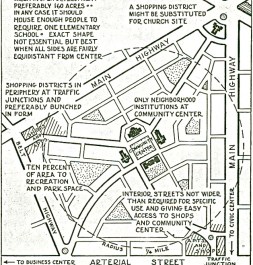
'Diagram No. 3', the school-centered ward. The modern origin of neighborhood planning? From Howard, Garden Cities of Tomorrow, 1902

Here, Howard encapsulated much of the neighborhood unit and then-contemporary “community center” movement, foreshadowed Clarence Perry by some 20 years, and, in his “Diagram No. 3,” perceptively showed the school at the ward’s center, a railroad station at the ward’s corner, and industry separated at the periphery.

As noted before, the challenges of integration of neighborhood and the city are not new, and may forever live on.

density and multi-modal, by any other name

Does the messaging which encourages sustainable forms of development need to alter its vocabulary to be successful?

Yesterday, Wednesday, January 5, I presented on removing barriers to transit-oriented development, sustainable communities and brownfields to a group of real estate lawyers from around the country assembled for a continuing legal education conference in Vail, Colorado.

The presentation is embedded below, and addresses in summary form the range of design, regulatory, fiscal and political issues in metropolitan areas today (with a Washington State focus). Yesterday, it was presented as the basis for a post-recession vocabulary for lawyers as well as clients and peer professionals.

Formal and casual discussion after the presentation was informative. We talked about the ongoing challenge of implementing compact and infill development adjacent to transportation infrastructure. Topics included infrastructure funding, urban streetcar initiatives, and how to address elements of walkable, transit-oriented development to constituencies not initially familiar with urbanist concepts or supportive of increased density.

Some in the audience suggested alternative language to mask hot-button words. Tax-increment financing to fund new infrastructure for transit-oriented development became a “parking fund”. Density was acknowledged as forever outside of some people’s comfort zone. And new neighborhoods aimed at live-work proximity were discussed as sometimes problematic in light of potential restrictions imposed by competing forms of environmental governance such as stormwater and air quality regulation.

I was reminded of twenty years ago, when drafting rural cluster development ordinances designed to protect natural resources. To some “cluster” meant “clutter’. We needed to call such regulations something else–such as “conservation density subdivisions”–to make them acceptable in many venues.

All in all, yesterday’s post-presentation discussions were illuminating in their own right, in response to provocative themes–and a reminder of the importance of holistic dialogue in the evolution from well-meaning dogma to achievable professional and political consensus.

Colorado January 2011

childhood urbanism: remembering Neighbor Flap Foot

Yes, I know that the authors of the Planetizen-based children’s book, Where Things are From Near to Far found my childhood idol lacking, noting how my favorite frog was outdated and “really trumpeted zoning as the ‘be all and end all’ of the development of cities”.

After all, the perceived shortcomings of the 1952 Neighbor Flap Foot, The City Planning Frog helped motivate Steins and Halbur to produce their own book on urban planning for children in 2008.

But those of us who grew up as children of urban planning professors, the words of of an obscure frog from long ago resonate anew in the age of compact development.

Consider the closing exercise in the book, after Flap Foot says goodbye for the winter:

Perhaps you and a group of your friends could plan ways to improve your neighborhood. You might want to build a model neighborhood, using boxes for houses , stores and other buildings. Draw BEFORE and AFTER pictures. Take BEFORE and AFTER snapshots of places in the neighborhood that you could work together to improve.

Do neighbors meet in your school in the evening? For fun and social affairs? Make a list of the places in your neighborhood where people can meet. Do you have playgrounds within a five-minute walk from your house? Are they safe enough for a little four-year old to reach by himself?

See if your COULD BE neighborhood has all that Flap Foot told Mickey a good neighborhood should have.

–Ewald and Henrickson, Neighbor Flap Foot, the City Planning Frog

Indeed, it could be that Neighbor Flap Foot will stage a comeback in the New Year.

gift-wrapping the essence of urbanism

Today’s populist urbanism celebrates the rise of the city, whether documented by census or science. Along the way, some note nostalgia when the long-time “Mom and Pop” store closes and urban places lose their distinction to author Jonathan Raban’s “rootless” feeling of anywhere.

Another facet of urbanism comes from that indescribable human dance of history, people and place that occurs when we simply like what we see. It is exciting when something resonates, such as purposefully preserved fragments of what was–more than Colonial Williamsburg or Sturbridge–but places which take us back to a sustainable set of circumstances with a simple, irrational gestalt: to live there for a year rather than a day, or to take the places home.

What if there were five neighborhoods connected by a trail? Or better yet, as illustrated from the Cinque Terre in northwest Italy, five towns, all self-contained, but symbiotic, micro-economies also connected by footpath, rail and water? What if they all had the magical amenities of street, square and housing within, terraced agriculture and spiritual retreats in the near-hinterlands?

The Cinque Terre towns of today have, in reality, evolved as a designated world heritage site and a national park with mechanisms to preserve and protect the cultural landscape (including often-abandoned hillside vineyards), and the internationally noted “look and feel” of interconnected towns.

Such regional “artifacts” raise the real question–need such places be facade-based shells, largely touristic, dominated in the summer by strangers rejoicing not just in local wine and pesto, but, ironically, the lack of cars and the wonders of a small-scale, interurban trek?

More than this year’s myurbanist topics of placemaking from ruins, learning from hill towns and chasing utopia, can the “we like what we see elements” be the stuff of daily life rather than a vacation? Similar sentiments dominate comparative blog and article references in recent months by Mssrs. Benfield and Epstein, who evoked ongoing work by Mahron and Mouzon, as well.

At this time of year such sentiments are worth repeating.

Over and above summer jaunts–and shipping home wine and pesto to remember and share–we should all bring home the gift of urban ideas. This gift honors not only of the spirit of the holidays, but also the spirit of implementation.

This article appeared in Crosscut on December 24, in Sustainable Cities Collective on December 20, and was featured by Kaid Benfield in his NRDC Switchboard blog on December 21.

defining provocative urbanism

provocative urbanism [pro·voc·a·tive ur·ban·ism] [noun]:  stimulating or controversial forms of urban community, which demonstrate vitality and human interaction reminiscent of traditional city life.

Amid today’s writing on cities, there is a theme afoot.  Something called provocative urbanism could define today’s excitement and communication about cities, as the focus of multiple articles, tweets, videos and lectures.

After all, we like cities when they work their magic of safe, dynamic and walkable multi-purposing, and provocative urbanism could aptly advertise such success.

No one has yet championed provocative urbanism among the many existing urbanisms of the airwaves. In particular, urbanism wordsmiths such as Yuri Artibise and Jason King haven’t kicked this tire (in fact, Yuri picked other monikers for his ‘P” Urbanism in his recent alphabetical list, starting with “paid”).

The Provocation

But just what are we provoking, and why and how?

Some of us are simply geeks about urban areas. Some see them as salvation—whether as city over suburb, or in the realm of economics, architecture, politics, law, transportation and health–or all together, in one of those silo-free nirvanas of sustainability, resplendent of both creative and contemporary buzz.

But a Google search for provocative urbanism produces surprisingly few results, and those which readily appear suggest an interesting theme: it is provocative to harken back to unplanned, spontaneous urban patterns in invoking our vision of the urban future.

In fact, one such Google result links to an essay on Richard Sennett’s The Uses of Disorder and champions urban complexity, randomness and conflict over prescriptive approaches that indiscriminately mandate technology (light rail) or policies (smart growth).

In an interesting, more structured parallel, Trent Noll has written recently in a Planetizen essay that the naturally occurring basics of placemaking (ie, comfort, variety, entertainment and walkability) have existed for time immemorial in successful cities, but today’s design challenge is a more purposeful implementation of such basics with a value-engineered mindset, to spur investment incentives for savvy developers.
At the center of provocation is the tension of imposition of order versus the wonders of a naturally changing city, often prompted by thematic catalysts and campaigns (e.g. Streets for All Seattle).

This tension is not new. Even in the 1920’s, colleagues of Clarence Perry critiqued his later well-known “neighborhood unit” approach in the context of the existing urban fabric of the New York region, then adapting to repercussions of automobile proliferation. Eminent Scottish town planner Thomas Adams wrote:

[D}iscussions… seem to suggest that neighborhood life is something that can be created. All city life is neighborhood life in some form. We should not discuss it as something that is non-existent and can be brought into being, but as something that exists in forms that need to be changed, improved and better organized. (Memorandum, Adams to Perry, January 23, 1928, Papers, Regional Plan Association, Cornell University).

Communicating the Provocation

There is something about the human condition that celebrates successful community, where and when we can co-exist safely, in a mutually supportive way. This especially rings true when this community can be conveyed through media that inspire the senses, much like the original experience of “being there”. As implied above, perhaps this celebration is most provocative when it occurs spontaneously, something seen more often in organic old world environments than in the new.

So, ironically, perhaps we wish to celebrate the successes of the unpredictable and disjointed as much as the successes of the prescriptive and planned. Unintentionally or outright, we often dwell in the incredible irony where the prescriptive and planned achieve what used to occur naturally.

Today, provocative urbanism can be communicated simply and democratically, which, frankly, adds even more provocation. With the wonders of technology and the grassroots web, we can now instantly connect around the world, and immediately display that the urban vernacular can be simultaneously multicultural and timeless, and that the two dimensions of print can easily become sight, motion and sound. Witness Seth Sherwood in the New York Times on December 1:

Damascus loves to flaunt its age. It claims to be the world’s oldest inhabited city — replete with biblical and Koranic lore, Roman ruins, ancient Islamic edifices and Ottoman-era palaces. But that’s not to say the Syrian capital is stuck in time. Dozens of centuries-old mansions have been reborn as Mideast-chic hotels, and fashionable shops and restaurants have arisen in the ancient lanes of the Old City. Throw in a fledgling generation of bars and clubs, and the age-old metropolis has never looked so fresh. [emphasis added]

In summary, today’s organizing institutions of land use–constitutional precepts of private property, or a zoning code or judge’s ruling–can be spun through time and space into a prospective dictionary term that adds even more color to the already crowded urban lexicon.

This article was authored as the introduction to a presentation, “Vignettes of Provocative Urbanism”, which will take place Thursday, December 9 in Seattle. Learn more via Great City, here.